A failed HVAC system doesn’t just make your building uncomfortable. It drives customers away, kills employee productivity, and can cost you thousands in lost revenue before lunch.
You’re dealing with Texas heat. Marion summers don’t wait for convenient timing. When your rooftop unit quits or your air handler starts making that noise, the clock starts ticking on how much this is going to cost you.
Fast response matters because every hour of downtime adds up. Research shows that quick diagnostic work can cut your total downtime by 35-45%. That’s the difference between a minor inconvenience and a business-threatening emergency. Our technicians arrive with the tools, parts, and experience to handle most commercial AC repair in Marion, TX on the first visit.
We’ve been handling industrial HVAC repair across San Antonio, Houston, and Austin for over 20 years. We’re veteran-owned, which means we show up when we say we will and we don’t leave until the job’s done right.
Marion businesses need contractors who understand the local climate and the urgency of commercial work. You’re not getting a residential crew trying to figure out your rooftop package unit. Our technicians are EPA certified, fully licensed, and trained specifically on commercial systems.
We’ve seen what happens when businesses try to stretch a failing system through one more season. It never works out cheaper. The emergency repair during your busiest week always costs more than the planned fix would have.
You call, we answer. Not a voicemail. Not a call center three states away. A real person who can get a technician moving toward your location.
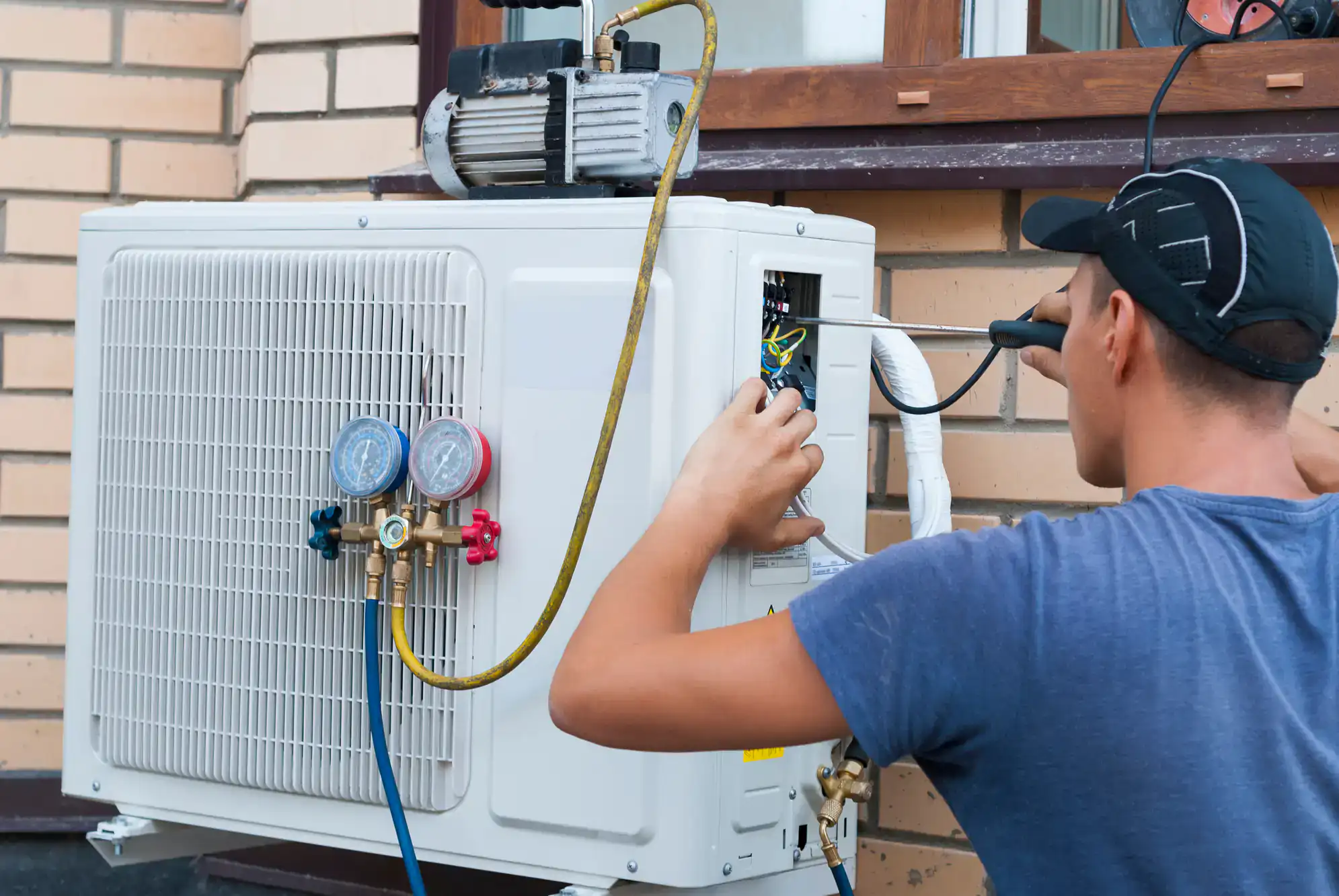
Our diagnostic process is thorough but fast. We’re checking refrigerant levels, electrical connections, airflow, and control systems. Most commercial HVAC issues fall into predictable categories once you’ve done this for 20 years. Compressor failures, refrigerant leaks, failed contactors, control board issues—we’ve seen them all in Marion’s climate.
If it’s a part we need to order, we’ll tell you exactly what it costs and how long it takes. No surprises. If we can fix it now, we do. Most repairs happen on the first visit because our trucks stock the components that actually fail on commercial systems in Texas.
After the repair, we test the system under load. We’re not leaving until your building is cooling properly and your system is running at the efficiency it should be.

Ready to get started?
Commercial systems are different animals than residential units. Larger capacity, more complex controls, rooftop installations that take a beating from Texas weather. Your system needs someone who works on commercial equipment regularly, not occasionally.
Marion’s commercial buildings—retail spaces, offices, light industrial facilities—typically run package units or split systems sized between 3 and 25 tons. These systems work harder than residential equipment. They run longer hours, handle more load variation, and they’re exposed to more environmental stress.
We handle compressor replacements, evaporator coil repairs, condenser fan motor failures, and control system troubleshooting. When your thermostat stops talking to your unit or your economizer dampers stick open, those aren’t DIY fixes. They require diagnostic equipment and someone who understands commercial control sequences.
Texas summers mean your system runs nearly year-round. A small efficiency loss compounds into serious money over a cooling season. We’re checking superheat and subcool, verifying proper airflow across coils, and making sure your system isn’t working twice as hard to deliver half the cooling.
We offer same-day service for commercial emergencies and we’re available 24/7 when your system fails outside business hours. Response time depends on where our technicians are when you call, but we prioritize commercial emergencies because we understand what downtime costs.
If you call at 2 PM on a Tuesday, we’re likely getting someone to you that afternoon. If your system fails at 10 PM on a Saturday, you’re still getting a certified technician, not a voicemail promising a callback Monday. We staff for emergencies because that’s when you actually need us.
Distance from San Antonio to Marion is manageable, and we’ve been serving this area long enough to know the fastest routes and the buildings we’ve worked on before. Repeat customers often get even faster response because we already know their systems.
A single emergency repair typically costs five to ten times what you’d spend on an annual maintenance plan. That’s not a sales pitch—it’s math that plays out every summer across Texas.
Maintenance catches the small stuff before it cascades. A refrigerant leak that loses a pound over six months is a $300 fix. That same leak ignored until your compressor runs dry and seizes? Now you’re looking at $3,000 to $8,000 depending on your system size. Contactors that show early signs of pitting get replaced for $150. Waiting until they fail and arc can take out your compressor or control board.
Emergency rates are higher because you’re paying for immediate availability and after-hours labor. The parts cost the same, but the urgency premium is real. Most businesses find that planned maintenance costs less annually than one major emergency repair.
We work on the commercial systems common to Marion-area businesses: rooftop package units, split systems, heat pumps, and light commercial applications up to 25 tons. If it’s cooling a retail space, office building, or light industrial facility, we’ve got the experience and parts access to handle it.
We don’t work on large industrial chillers or specialized process cooling—that’s a different specialty requiring different equipment. But the package units and split systems that cool 90% of Marion’s commercial buildings? That’s our daily work.
Our technicians are trained on major brands and we stock parts for the systems actually installed in Texas. Carrier, Trane, Lennox, Rheem, Goodman—we’re familiar with their commercial lines and their common failure points in this climate.
Age and repair cost are your main factors. If your system is under 10 years old and the repair costs less than half of a new system, repair usually makes sense. If you’re looking at a major component failure on a 15-year-old unit, replacement often pencils out better.
We’ll give you both options with real numbers. A compressor replacement might run $4,000 on a system that’s worth $8,000 new. If that system is already 12 years old, you’re putting major money into equipment that’s likely to need more expensive repairs soon. Sometimes the smart move is cutting your losses.
Energy efficiency matters too. A new commercial unit can run 30-40% more efficiently than a 15-year-old system. On equipment that runs 3,000+ hours per year in Texas, that efficiency gain pays for itself faster than you’d think. We’ll calculate your actual operating costs both ways so you can make an informed decision.
Texas heat and runtime hours are your biggest enemies. Commercial systems in Marion run hard from April through October, and that extended cooling season accelerates wear on every component.
Compressor failures top the list, usually caused by refrigerant issues, electrical problems, or lack of maintenance. Contactors and capacitors fail regularly because they’re switching high loads thousands of times per season. Control boards get cooked by heat exposure on rooftop installations. Condenser coils clog with cottonwood, dust, and debris, forcing your system to work harder and run hotter.
Refrigerant leaks are common in older systems, especially where vibration and thermal cycling stress the copper lines. Marion’s temperature swings—90s during the day, 70s at night—create expansion and contraction that eventually finds weak points in your refrigerant circuit. Catching these early in a maintenance visit costs a fraction of what you’ll pay when the leak empties your system and kills your compressor.
Absolutely. Most commercial systems we diagnose are running 15-30% less efficiently than they should be, usually from maintenance neglect or component degradation. That inefficiency shows up every month on your electric bill.
We start with airflow—checking filters, coils, and blower operation. Restricted airflow is the easiest efficiency killer to fix and often the most overlooked. Then we verify refrigerant charge, because systems running low work much harder to deliver the same cooling. A system that’s two pounds low might run an extra 4-6 hours per day trying to maintain temperature.
Control optimization matters too. If your economizer isn’t working or your staging controls are misconfigured, you’re conditioning air you don’t need to or running at full capacity when partial would suffice. We’ve cut energy costs 20-25% for Marion businesses just by fixing controls and cleaning coils. The work pays for itself in months, not years.
Other Services we provide in Marion
 Call Now