
Summary:
Replacing an AC system in Bexar County is already a significant investment. The last thing you want is to find out afterward that you qualified for hundreds of dollars back from CPS Energy — and missed it because no one told you about the deadline. That happens more often than it should. CPS Energy’s STEP program offers real rebates on qualifying HVAC equipment, but the process has specific requirements that most contractors never walk you through. We’re going to change that. By the end of this page, you’ll know exactly what’s available, what you need to qualify, and what to ask your contractor before the job starts.
What Is the CPS Energy STEP Program and Who Qualifies in Bexar County?
CPS Energy — the nation’s largest municipally-owned utility and the provider serving virtually every home in Bexar County — runs a rebate program called STEP, short for Sustainable Tomorrow Energy Plan. It was authorized by the City of San Antonio in June 2022 with a straightforward goal: help residents use less energy by making efficient equipment more affordable to buy.
If you’re a CPS Energy residential customer replacing a central AC system, heat pump, or ductless mini-split, you may qualify for a rebate based on the efficiency rating of the new equipment. The rebate is paid per cooling ton, so the size of your system matters too. A standard 3-ton system can earn you $825 or more back. A 5-ton system at a high efficiency tier can return $1,375.
The key eligibility basics: you need to be a current CPS Energy customer, the installation must be done by a licensed HVAC contractor who can do AC Repair for the rebate application has to be submitted within 30 days of installation. That deadline is firm.
How Much Can You Get Back? CPS Energy Rebate Tiers Explained
The rebate amount is tied to the SEER2 efficiency rating of the system you install. SEER2 replaced the old SEER standard in January 2023 as the federal efficiency benchmark for all new HVAC equipment. The higher the SEER2 rating, the more efficient the system — and the more CPS Energy pays back.
Here’s how the tiers work under the Replace on Burnout pathway, which applies when your existing system has failed or is beyond the eligible age: at SEER2 13.8 to 15.1, you get $90 per cooling ton. At SEER2 15.2 to 16.1, that jumps to $120 per ton. SEER2 16.2 to 17.0 earns $150 per ton. At SEER2 17.1 to 19.9, the rebate is $225 per ton. And at SEER2 20.0 or above, you’re looking at $275 per cooling ton.
To put that in real numbers: a 3-ton system at SEER2 18 falls into the Tier 4 bracket, earning $675. Push that same system to SEER2 20 and you’re at $825. A 5-ton system at SEER2 20 returns $1,375 from CPS Energy alone.
There’s also an Early Replacement pathway — separate from Replace on Burnout — for homeowners who want a AC replacement that still works but is aging or inefficient. The payout structure differs, and in some cases it’s more favorable. If your system is under 25 years old (or under 20 years for heat pumps) and still operational, it’s worth asking whether the Early Replacement path makes more financial sense for your situation before you wait for it to fail.
One more thing worth knowing: the federal Section 25C energy efficiency tax credit was eliminated on July 4, 2025. As of 2026, there is no federal tax credit available for residential AC or heat pump purchases. CPS Energy’s STEP rebates are now the primary financial incentive available to Bexar County homeowners, which makes understanding this program more important than ever. If a contractor or website is still mentioning the federal credit as an available benefit, that information is out of date.
The 30-Day Rebate Deadline — and Why Most Homeowners Miss It
This is the detail that costs people the most money, and it almost never gets mentioned upfront. CPS Energy requires that your rebate application be submitted within 30 days of installation. Not 60 days. Not 90. Thirty days, and there are no extensions.
The application itself requires documentation that needs to come from your contractor: the AHRI certificate number for the matched equipment (this verifies the system’s efficiency rating with a third-party organization), photos of the installation, and the model and serial numbers of both the old and new equipment. If you’re having work done inside San Antonio city limits, there’s one more layer — a permit number is required before CPS Energy will process the rebate. That means your contractor has to pull a permit for the job. Not every contractor does this automatically, and if they don’t, your rebate gets denied.
This is why who you hire matters as much as what you buy. A contractor who doesn’t pull permits, doesn’t provide the AHRI certificate, or doesn’t flag the 30-day deadline is a contractor who may cost you hundreds of dollars in forfeited rebates — regardless of how good the installation is.
The safest approach is to have your contractor gather every piece of documentation on installation day and submit the application before leaving. Waiting even a week to track down paperwork creates unnecessary risk when the clock is already running.
For Bexar County homeowners in particular, it’s also worth knowing that CPS Energy offers a free High-Performance A/C Tune-up — valued at around $200 — for qualifying residential customers with operational central AC. This isn’t a replacement rebate, but it can improve cooling output by up to 25% and is available at no cost. If your system is aging but not yet at the replacement point, this is a practical starting place.
How to Choose an HVAC Contractor Who Won't Cost You Your CPS Energy Rebate
The rebate process puts a real burden of proof on the contractor. They need to be TDLR-licensed — that’s the Texas Department of Licensing and Regulation, which governs HVAC work in the state. Unlicensed work is illegal in Texas and will get your rebate denied. Beyond licensing, they need to pull permits for work inside San Antonio city limits, provide the AHRI certificate for the matched equipment, and document the existing system before it’s removed.
Most homeowners don’t know to ask for any of this until after the job is done and the rebate is denied. Asking the right questions before you hire — “Are you TDLR-licensed?”, “Will you pull a permit?”, “Can you provide the AHRI certificate number?” — takes about two minutes and can save you over a thousand dollars.
What to Ask Before Hiring an HVAC Company in Bexar County
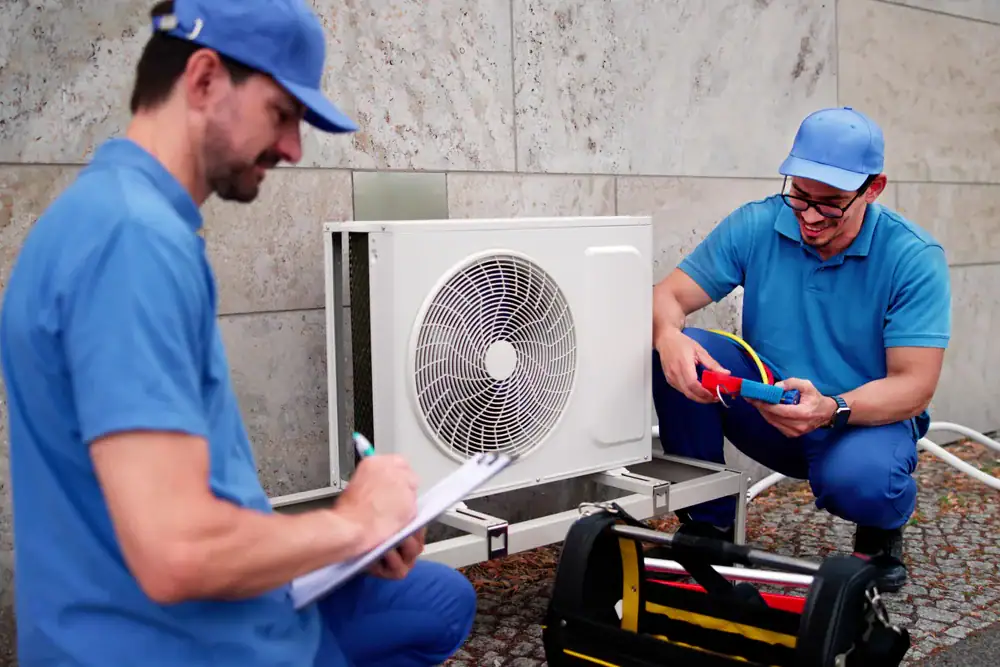
Bexar County’s HVAC market is competitive, and most companies will tell you what you want to hear on the phone. The difference shows up in the details — specifically, whether they handle the rebate documentation or leave it entirely to you.
A few questions worth asking any contractor before you commit: Do you pull permits for work inside San Antonio city limits? Can you provide the AHRI certificate number for the matched system? Will you document the existing equipment before removal? And will you help me submit the CPS Energy rebate application within the 30-day window?
If a contractor hesitates on any of those, that’s useful information. It doesn’t necessarily mean they do bad work, but it does mean the rebate paperwork may fall entirely on you — and if you’re not familiar with the process, that’s a real risk.
Proper system sizing is another question worth raising. The industry standard is a Manual J load calculation, which accounts for your home’s orientation, window types, insulation, and local climate to determine the right tonnage. Many contractors skip this and size by square footage alone, which often results in a system that’s too large — it short-cycles, wears out faster, and doesn’t dehumidify properly. In Bexar County’s humid subtropical climate, that last part matters. A correctly sized system will run longer cycles and pull more moisture out of the air, which makes your home feel cooler at a higher thermostat setting.
We’ve been doing this in Bexar County for over 20 years. We know the neighborhoods — Converse, Schertz, Universal City, Helotes, the Northside, the Southside — and we know the housing stock. Homes built in the 1970s through the 1990s in this area are hitting replacement age right now, and a lot of those systems are oversized by today’s standards. Getting the sizing right on the replacement is one of the most important decisions you’ll make, and it directly affects both your monthly bill and your CPS Energy rebate tier.
Real Questions Bexar County Homeowners Ask About CPS Energy HVAC Rebates
**Can renters get CPS Energy HVAC rebates?** Generally, no — the rebate goes to the CPS Energy account holder, which is typically the property owner. If you’re renting, the decision and the rebate belong to your landlord. If you own your home and are a CPS Energy customer, you’re the one who qualifies.
**What if my system already failed — can I still get a rebate?** Yes. The Replace on Burnout pathway exists specifically for this situation. You don’t need a working system to qualify. You do still need the 30-day deadline, the permit (if inside San Antonio city limits), and the AHRI certificate for the new equipment. The rebate amounts under Replace on Burnout are the tier figures listed earlier — $90 to $275 per cooling ton depending on SEER2 rating.
**Are there programs for homeowners who can’t afford a new system?** CPS Energy does offer income-qualified assistance programs that go beyond rebates — including free weatherization, insulation, and in some cases free equipment upgrades for eligible households. In Bexar County, where roughly 11% of residents fall below the federal poverty line, these programs serve a real need. If you’re not sure whether you qualify, it’s worth a call to CPS Energy directly or asking your contractor about income-qualified pathways.
**Does the brand of AC matter for the rebate?** No — the rebate is based on the SEER2 efficiency rating and the AHRI certificate, not the brand. What matters is that the matched system (the combination of indoor and outdoor units) is certified at the efficiency tier you’re claiming. Your contractor should verify this before ordering equipment.
**How long does it take to receive the rebate?** CPS Energy processes rebate applications and typically issues payment by check. Processing times vary, but submitting online (rather than by paper form) generally speeds things up. Plan for several weeks from submission to receipt.
**What about cedar season and air quality — does that affect my HVAC system?** This one’s specific to Bexar County and worth addressing directly. Mountain cedar pollen season runs from December through February, and the counts in this area are among the highest in the world during that window. That pollen gets pulled into your HVAC system constantly, clogs filters faster than normal, and can settle into ductwork over time. If you’re replacing your system, it’s a good time to evaluate your duct condition as well — especially in older homes where ducts may not have been cleaned or inspected in years. Indoor air quality in Bexar County is a year-round concern, not just a summer one.
Getting the Most Out of Your AC Replacement in Bexar County
The CPS Energy STEP program is one of the most straightforward ways to reduce the cost of an HVAC upgrade in Bexar County — but only if the paperwork is handled correctly and the deadline is met. The rebate tiers are real, the dollar amounts are meaningful, and the process is manageable when you work with a contractor who knows what’s required.
The short version: choose a SEER2-rated system that qualifies for a higher rebate tier, confirm your contractor is TDLR-licensed and will pull the required permit, get the AHRI certificate number documented on installation day, and submit the application within 30 days. That’s the whole process.
If you’re not sure where your existing system stands or whether replacement makes more financial sense than repair, that’s exactly the kind of conversation we’re built for. We’ve been serving Bexar County for over 20 years — we know this market, we know CPS Energy’s program, and we’re not going to recommend something you don’t need. Give us a call and we’ll give you a straight answer.