
Summary:
Your AC started making a noise. Maybe it’s a low hum you haven’t noticed before, or a bang that made you put down your coffee. You’re not sure if it’s serious, and you’re not ready to call someone until you have a better idea of what you’re dealing with.
That’s a reasonable place to be. Not every sound means your system is about to fail. But some of them do — and in Austin, TX, where your air conditioner runs 12 to 16 hours a day through triple-digit summers, the margin for error is smaller than in most places. Here’s what those sounds usually mean, and how to figure out whether this is a wait-and-see situation or a call-today one.
What Different AC Noises Actually Mean
Your air conditioner communicates through sound more than most people realize. A system running well is mostly quiet — a steady hum, the whoosh of air through vents, maybe a click when it kicks on or off. When something changes, there’s usually a reason, and the type of noise often points directly to the source.
The challenge is that some sounds are genuinely minor — a loose screw, a piece of debris that found its way into the condenser — while others signal something that will get significantly worse if you keep running the system. Knowing the difference matters a lot when it’s 104 degrees outside and you can’t afford to be without cooling for three days.
Banging, Rattling, and Buzzing: What's Going On Inside Your System
A banging noise coming from your AC — especially from the outdoor unit — is one of the sounds that warrants turning the system off and making a call. It usually means something is loose or broken inside the compressor: a piston pin, a crankshaft component, or a connecting rod that’s come free and is striking other parts with every cycle.
Running the system while it’s banging is like driving a car with a knocking engine. The damage compounds with each rotation, and what might have been a contained repair can turn into a full compressor replacement.
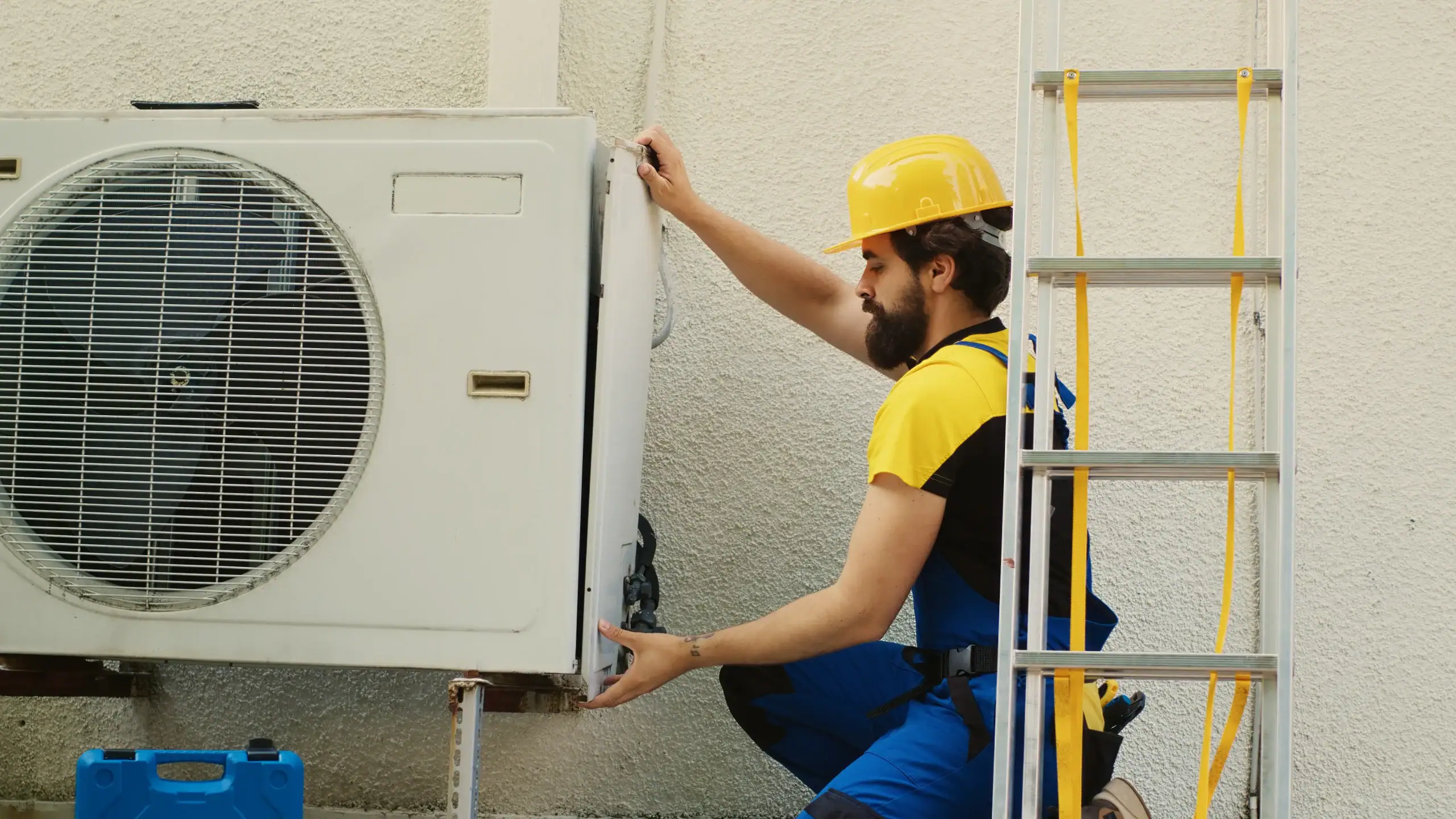
Rattling is a different story — and it’s worth checking the simple things first. Leaves, twigs, and debris can work their way into the condenser unit, especially in Austin during spring and fall when wind picks up. If the rattle is coming from outside and sounds like something loose rolling around, turn the system off and visually inspect the unit.
If you don’t see anything obvious, or if the rattle is coming from inside the air handler, that’s when a technician should take a look. Loose panels, a failing blower fan, or early compressor wear can all produce a rattle that isn’t immediately visible.
Buzzing tends to make homeowners nervous, and it should — but not always for the same reason. A buzzing sound from your AC can come from a failing capacitor, a deteriorating contactor, loose fan blades, or a refrigerant issue. Capacitors are one of the most common failure points in Austin systems, and it makes sense when you think about the load they carry.
During a heat wave, your system is running almost continuously, and the electrical components take a beating. A capacitor that’s starting to fail will often buzz before it goes out completely. The good news is that capacitor replacement is one of the more straightforward repairs. The concern is that a buzzing sound can also indicate a refrigerant leak or an electrical issue — both of which require a licensed technician. HVAC systems run at 240 volts, and larger commercial systems run higher than that. This is not a category of repair where DIY troubleshooting makes sense.
Squealing, Hissing, and Clicking: When to Turn It Off Immediately
A high-pitched squealing or screeching sound is one of the more alarming things an AC can produce — and it usually earns that reaction. In older systems, squealing often points to a worn fan belt or damaged blower motor bearings. In newer systems that don’t use belts, a squeal from the compressor area can indicate dangerously high internal pressure.
If the sound is sharp, metallic, and coming from the compressor, turn the system off and call for service. Operating a system under excessive compressor pressure risks serious damage to the unit.
Hissing is another sound that deserves immediate attention. A steady hiss — particularly from the refrigerant lines or the indoor air handler — often means refrigerant is escaping. Refrigerant leaks aren’t just a mechanical problem; handling refrigerant is regulated under federal law and requires EPA Section 608 certification.
It’s not something that can be topped off at a hardware store or patched with a DIY fix. If you hear hissing and your home isn’t cooling the way it should, those two things together are a strong signal to stop running the system and get a certified technician out.
Clicking is the one that causes the most unnecessary worry. A single click when your system turns on or shuts off is completely normal — it’s just the thermostat and the system communicating. What’s not normal is persistent clicking during operation, or repeated clicking that happens every few minutes.
That pattern usually points to a defective relay switch, a failing thermostat, or a control board issue. It won’t cause immediate catastrophic damage the way a banging compressor might, but it won’t resolve on its own either, and it tends to get worse over time.
When to Call for AC Repair in Austin — and Why Waiting Costs More
The most common mistake Austin homeowners make with AC noises isn’t ignoring them entirely — it’s putting off the call for a few days to see if the sound goes away. Sometimes it does. More often, the underlying issue continues to wear on other components while the system runs, and what started as a relatively minor repair becomes a much larger one.
Austin’s summers make this dynamic more acute than in most markets. With an average of 37 triple-digit days per year since 2000 — and some recent summers pushing well past that — your system doesn’t get much of a break between June and September. That continuous load accelerates wear in ways that simply don’t happen in milder climates.
How Austin's Heat Turns Small AC Problems Into Big Ones
Think about what your air conditioner goes through during an Austin summer. In 2023, the city recorded more than 45 triple-digit days, including a stretch of 20 consecutive days where the temperature never dropped below 100°F. During that kind of heat, your system isn’t cycling on for 20 minutes and resting — it’s running nearly continuously, hour after hour, day after day.
The thermal stress on capacitors, contactors, fan motors, and compressors during that kind of sustained load is significant. A capacitor that’s starting to fail might buzz quietly for a week before it goes out completely. Under normal conditions in a milder climate, that week might give you enough time to schedule a non-emergency appointment. In Austin in July, a failed capacitor means your compressor is trying to start without the electrical boost it needs — and compressors that struggle to start repeatedly can burn out. That changes the repair picture considerably.
The same logic applies to refrigerant issues. A slow leak might let your system limp along for a while, gradually losing cooling capacity. But running a system low on refrigerant causes the compressor to work harder to compensate, which generates more heat, which accelerates wear. By the time the cooling loss becomes obvious, the damage to the compressor may already be done.
There’s also the timing problem. During peak summer demand in Austin, HVAC companies book up fast. If you wait until your system fails completely, you may be looking at several days without cooling — not because the repair is complicated, but because every technician in the area is already scheduled. Calling when you first notice a noise, rather than after the system stops working, gives you more options and usually results in a faster resolution.
Austin’s housing stock adds another layer to this. Older homes in East Austin, Hyde Park, and the South Congress corridor often have systems that have been running for years with deferred maintenance. These systems are more vulnerable to the kind of cascading failures that a strange noise can signal. Newer construction in Cedar Park, Round Rock, and Pflugerville sometimes has systems that were sized or installed quickly during the building boom — which can create its own set of early-onset issues. The noise your system is making right now is worth taking seriously regardless of how old it is.
What Happens When a Certified Technician Looks at Your System
One of the things that makes AC noise calls frustrating for homeowners is not knowing what to expect when a technician shows up. Will we find something minor? Will we tell you the whole system needs to go? Will we explain what we found, or just hand you a quote?
Our approach is straightforward. Our technicians are EPA-certified and TDLR-licensed, which matters for anything involving refrigerant or electrical components — both of which come up frequently in noise diagnostics. When we identify a problem, we show you what we found. That might mean a photo of a failed capacitor, a demonstration of a loose component, or a clear explanation of what the sound was and what caused it. You understand what’s wrong before any work begins.
Most AC repair jobs in Austin get handled on the first visit because our trucks are stocked with the parts that fail most often in this climate — capacitors, contactors, refrigerant, and the components that take the hardest hit during sustained summer heat. That means you’re not waiting on a parts order in the middle of a heat wave.
We’re also honest about what we find. If the noise is coming from something minor, we’ll tell you that. If a repair makes more financial sense than replacement, we’ll tell you that too. And if a system genuinely is at the end of its useful life, we’ll explain why and give you clear options — not a sales pitch. That’s the veteran-owned approach we’ve operated by for over 20 years, and it’s the reason customers in Austin call us back when something sounds wrong again.
Our 24/7 emergency line is answered by real people, not an answering service. If you’re hearing a banging noise at 10 PM in July and you’re not sure whether it’s safe to keep the system running, you can call and get an actual answer — not a voicemail and a callback the next morning.
Getting AC Noise Diagnosed Right the First Time in Austin
Strange AC noises don’t always mean the worst, but they rarely mean nothing. The type of sound, where it’s coming from, and how long it’s been happening all point toward a diagnosis — and getting that diagnosis right the first time matters, especially when Austin summers don’t leave much room for a system to be down.
If you’re hearing something that doesn’t sound right, the most useful thing you can do is pay attention to when it happens, where it seems to be coming from, and whether your system is still cooling effectively. That information helps a technician narrow things down quickly and get your system back where it needs to be.
Texas Air Repair handles AC diagnostics and repairs across Austin, TX — residential and commercial, routine and emergency. If something sounds off, we’re straightforward about what it is and what it takes to fix it. Call us 24/7 when you need answers.