
Summary:
Your AC just stopped working. It’s 102 degrees outside, and your house is already starting to feel like an oven. You’re sweating, your family’s uncomfortable, and you’re wondering whether this is something you can fix yourself or if you need to call someone right now.
That moment of panic is real, especially in San Antonio, TX, where summer temperatures regularly push past 100 degrees and AC isn’t a luxury—it’s essential for safety. The good news is that some AC breakdowns have simple causes you can troubleshoot in minutes, while others need professional attention fast. Knowing the difference can save you time, money, and a lot of unnecessary stress.
Here’s what you need to know when your air conditioner fails at the worst possible moment, starting with the most common culprits behind sudden breakdowns.
What Causes Sudden AC Breakdowns in San Antonio Homes
Most emergency AC failures don’t happen randomly. They’re usually the result of stress, neglect, or simple mechanical issues that finally reached a breaking point.
In San Antonio’s climate, your AC works harder and longer than systems in milder regions. When you’re running your unit nearly year-round and pushing it through months of triple-digit heat, components wear down faster. Capacitors fail. Compressors overheat. Refrigerant levels drop.
Sometimes the issue is environmental. A sudden power surge during a summer storm can trip breakers or damage electrical components. Dust and debris from Texas winds clog outdoor units. Even something as simple as a forgotten air filter can suffocate your system until it shuts down completely.
Understanding these common causes of urgent AC repair needs helps you know where to look first when your system stops cooling.

Check Your Thermostat Settings Before Anything Else
It sounds almost too simple, but thermostat issues cause more “emergency” service calls than you’d think. Before you assume the worst about your AC system, take 30 seconds to verify your thermostat is actually calling for cooling.
Make sure it’s set to “cool” mode, not “fan” or “heat.” Check that the temperature setting is at least a few degrees below your current indoor temperature. If you have a programmable or smart thermostat, confirm it hasn’t switched to an energy-saving mode or schedule that’s keeping the AC from running.
Look at the display. If it’s blank or dim, the batteries might be dead. Replace them and wait a minute to see if the system kicks back on. If you have a newer digital thermostat, try turning it completely off, waiting 30 seconds, then turning it back on to reset it.
Check the thermostat’s location too. If it’s mounted near a window with direct sunlight, a heat-producing appliance, or a drafty door, it might be getting false temperature readings that prevent your AC from running properly. Sometimes the sensor inside gets knocked out of position, especially in older units.
If your thermostat seems fine but your AC still won’t respond, the issue is likely with the system itself. But ruling out thermostat problems first saves you from an unnecessary service call and gets you one step closer to identifying the real issue.
How to Troubleshoot Power and Electrical Issues When Your AC Won't Turn On
If your AC won’t turn on at all, you’re probably dealing with an electrical problem. These issues range from simple fixes you can handle in seconds to serious hazards that need immediate professional attention.
Start at your home’s electrical panel. Find the breaker labeled for your air conditioner and check if it’s tripped. A tripped breaker sits in the middle position between “on” and “off,” or sometimes it just looks slightly off-center. If it’s tripped, flip it all the way to the “off” position first, then firmly push it to “on.”
Try running your AC again. If the breaker immediately trips again, stop. Don’t keep resetting it. A breaker that trips repeatedly is protecting your home from a serious electrical problem—possibly a short circuit, a failing compressor, or damaged wiring. Continuing to reset it won’t fix the issue and could create a fire hazard.
Check the outdoor disconnect box next to your condenser unit. This gray or metal box has a pull-out block or switch that cuts power to the outdoor unit. Make sure it’s fully pushed in or switched to the “on” position. Sometimes it gets bumped during yard work or maintenance.
Look for an emergency shutoff switch near your indoor air handler, usually mounted on the wall nearby. It looks like a regular light switch and is often in a red or metal box. Someone might have accidentally flipped it off.
If you smell burning, see sparks, or notice any melted wiring or components, don’t touch anything. Turn off power to the AC at the breaker and call for emergency AC repair immediately. Electrical issues can escalate fast, and trying to fix them yourself puts you at serious risk.
Some electrical problems are simple—a tripped breaker, a flipped switch, or a blown fuse you can replace. But if you’ve checked these basics and your AC still won’t power on, or if you see any signs of electrical damage, you need a licensed HVAC technician to diagnose and repair the problem safely.
Simple DIY Checks That Might Restore Your AC
Before you pick up the phone for emergency service, there are a few straightforward things you can check yourself. These aren’t complex repairs—they’re maintenance basics that homeowners can safely handle and that solve a surprising number of AC problems.
You’re looking for the obvious stuff: clogged filters, blocked airflow, dirty outdoor units, and other issues that prevent your system from doing its job. If you can eliminate these common culprits in the next 10 minutes, you might save yourself a service call and get your AC running again right away.
Even if these checks don’t solve the problem, you’ll have valuable information to share with a technician when you do call for same-day AC repair, which can speed up the repair process.
Replace or Clean Your Air Filter Immediately
A clogged air filter is one of the most common reasons an AC stops cooling effectively or shuts down completely. When your filter gets packed with dust, pet hair, and debris, it chokes off airflow to your system. Your AC has to work harder, components overheat, and eventually the system protects itself by shutting down.
Find your air filter first. In most homes, it’s located in the return air duct near your indoor air handler, or sometimes in a slot on the furnace itself. Pull it out and hold it up to the light. If you can’t see light passing through it, or if it’s visibly gray and clogged, it needs to be replaced immediately.
Don’t try to clean a disposable filter—just replace it with a new one that matches the size printed on the filter frame. Make sure you install it with the airflow arrow pointing in the right direction, toward the blower. If you have a reusable filter, rinse it thoroughly with water, let it dry completely, and reinstall it.
How often should you change your filter? In San Antonio’s dusty climate with near-constant AC use, every 30 to 60 days is smart. If you have pets, allergies, or run your system heavily, check it monthly. A clean filter is cheap insurance against bigger problems.
After replacing the filter, give your AC about 10-15 minutes to see if it starts cooling properly again. If airflow was the only issue, you should notice a difference fairly quickly. If your system still isn’t working right, the problem goes deeper than the filter.
Ignoring your air filter doesn’t just hurt cooling performance. It can lead to frozen evaporator coils, blower motor failure, and even complete system breakdowns. It’s the single easiest maintenance task that prevents emergency repairs, yet it’s the one homeowners skip most often.
Inspect Your Outdoor Unit for Blockages and Debris
Your outdoor condenser unit needs to breathe. When it’s surrounded by weeds, covered in cottonwood fluff, or clogged with leaves and debris, it can’t release heat effectively. The result is an overworked system that either cools poorly or shuts down to protect itself from damage.
Go outside and take a close look at your condenser. Clear away any grass clippings, leaves, branches, or other debris within at least two feet of the unit on all sides. Check the top of the unit too—sometimes leaves and debris collect on the fan guard.
Look at the fins on the outside of the unit. These thin metal strips should be relatively clean and straight. If they’re bent, packed with dirt, or covered in cottonwood seeds, your unit can’t exchange heat properly. You can gently rinse the fins with a garden hose on a low setting, spraying from the inside out to push debris away from the unit.
Don’t use a pressure washer—the force can bend the delicate fins and make the problem worse. And make sure you turn off power to the unit at the disconnect box before you start spraying water anywhere near it.
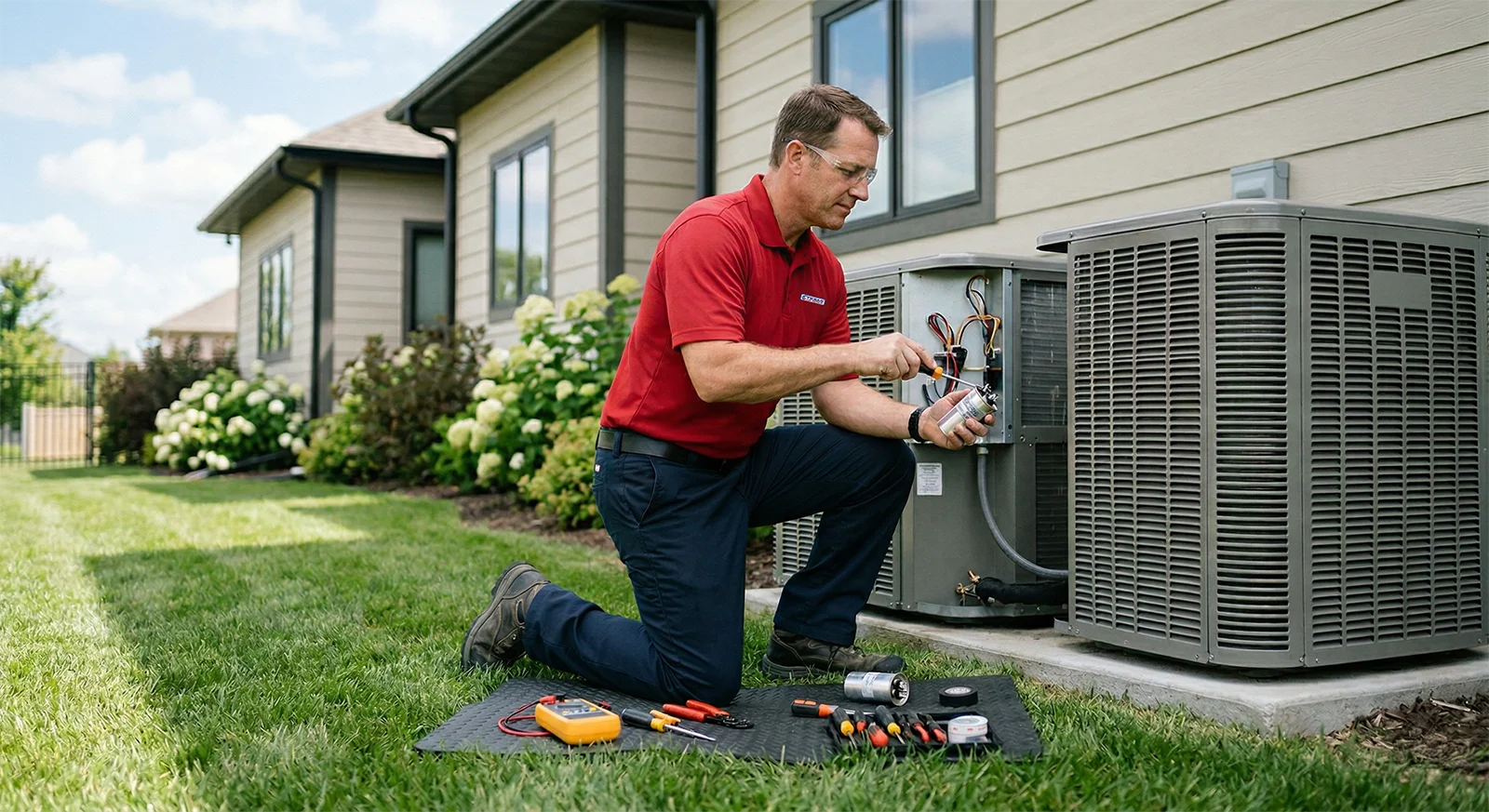
Check that the fan inside the top of the unit is spinning when the AC is running. If it’s not, you’ve found your problem. A failed fan motor or capacitor needs professional repair, but at least you know what’s wrong.
While you’re outside, make sure nothing is blocking airflow to the unit. Sometimes landscaping grows too close, or storage items get stacked nearby. Your condenser needs clear space to pull in air and exhaust heat. Without it, even a perfectly functioning system will struggle.
San Antonio’s climate is tough on outdoor units. Dust storms, pollen, and constant sunshine all take a toll. Making outdoor unit inspection part of your routine—especially before and during peak cooling season—can prevent a lot of emergency breakdowns before they happen.
When to Call for Professional Emergency AC Repair in San Antonio
Some AC problems are beyond DIY fixes, and knowing when to call a professional can be the difference between a quick repair and a complete system failure. If you’ve checked your thermostat, replaced your filter, inspected your outdoor unit, and verified power is reaching your system, but your AC still isn’t working, it’s time to bring in a technician.
Certain situations demand immediate professional attention. If you smell burning, see smoke, hear loud grinding or screeching noises, or notice water pooling around your indoor unit, don’t wait. These are signs of serious problems that can cause safety hazards or extensive damage if ignored.
Refrigerant leaks, frozen coils, failed compressors, and electrical malfunctions all require specialized tools, training, and licensing to repair safely. Attempting these repairs yourself can void warranties, create dangerous situations, and often make the problem worse.
In San Antonio’s extreme heat, a broken AC isn’t just uncomfortable—it can be dangerous, especially for young children, elderly family members, and anyone with health conditions. When temperatures inside your home start climbing past 90 degrees and your AC won’t respond to basic troubleshooting, that’s an emergency.
At Texas Air Repair, we understand the urgency of AC failures in San Antonio, TX. With over 20 years of experience, 24/7 emergency availability, and certified technicians who provide transparent pricing, we’re equipped to handle urgent repairs when you need them most. Whether it’s a midnight breakdown or a weekend failure during a heat wave, we’re here to help when DIY solutions aren’t enough.