
Summary:
If your commercial HVAC system is aging out or you’re planning a renovation, you’ve probably run into the term VRF and wondered whether it’s worth the conversation. It’s a fair question — and an important one, because the system you choose will affect your energy bills, your tenants or customers, and your maintenance headaches for the next decade or more.
San Antonio’s climate doesn’t forgive bad HVAC decisions. With summers that regularly push past 100°F and a cooling season that stretches well beyond what most of the country deals with, the stakes are real. Here’s what you need to know before you make a call.
What Is a VRF System and How Is It Different from Traditional HVAC?
Traditional HVAC — the kind most commercial buildings in Bexar County already have — works by heating or cooling air and pushing it through ductwork to the whole building at once. It’s a single system treating the entire space as one zone. That works fine for a lot of applications, but it has real limitations when your building has areas with different needs.
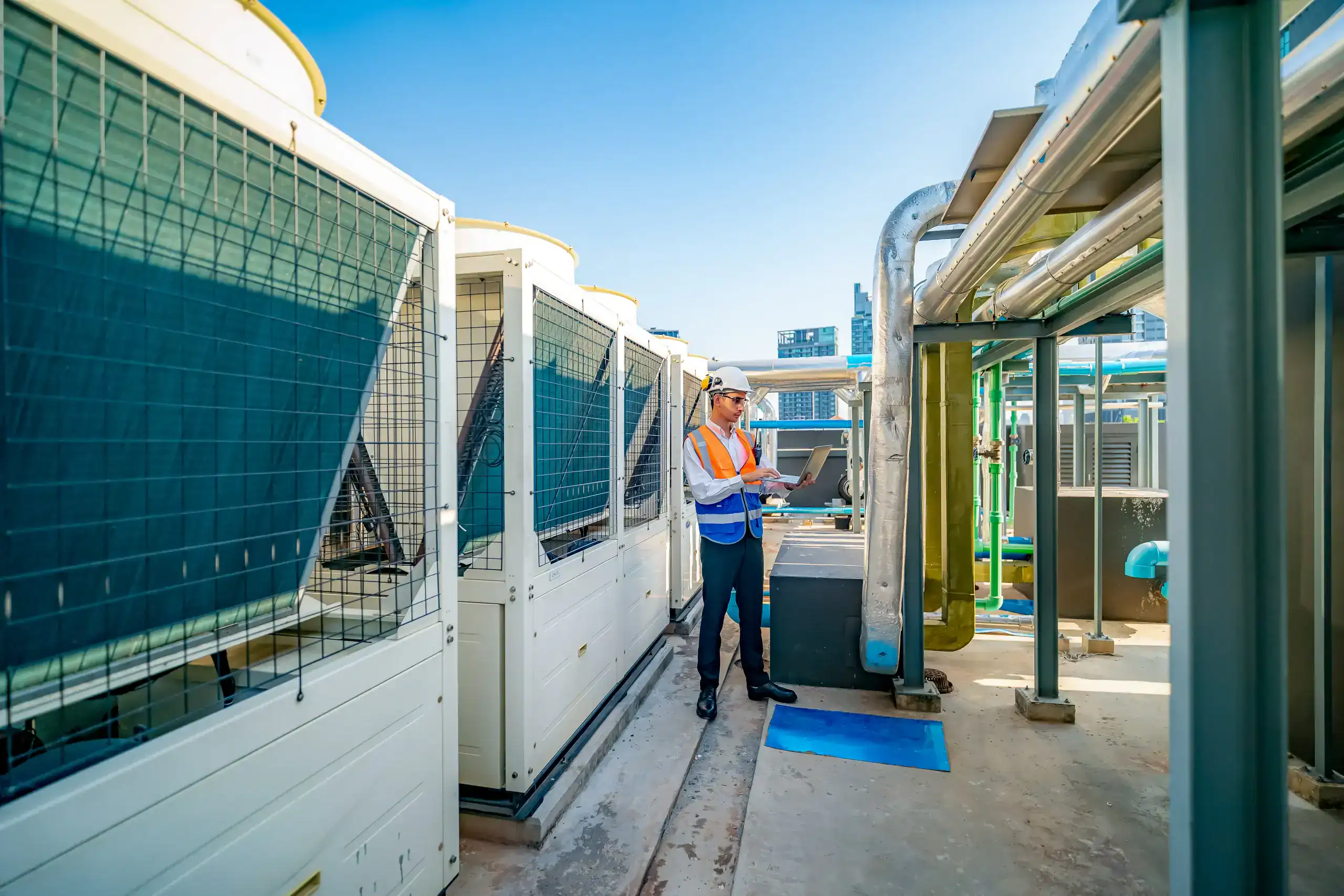
VRF stands for Variable Refrigerant Flow. Instead of moving air through ducts, it moves refrigerant directly to individual air handlers placed throughout the building. Each zone gets its own control. The dining room can run cooler than the kitchen. The conference room can be conditioned without overcooling the private offices around it. The system adjusts output continuously rather than cycling on and off, which is where the efficiency gains come from.
How Does a VRF System Actually Work Day to Day?
The core difference in day-to-day operation comes down to how the system responds to demand. A traditional split system or rooftop unit is essentially binary — it’s either running at full capacity or it’s off. When the thermostat calls for cooling, the compressor kicks on hard, cools the space down, then shuts off. This cycle repeats all day. In a San Antonio summer, that means your system is working at full blast during the hottest hours, then cutting off, then starting again — which is hard on equipment and not particularly efficient.
A VRF system uses a variable-speed compressor that modulates continuously. It ramps up when demand is high and dials back when it isn’t, rather than stopping and starting. This steady operation is gentler on the equipment and more precise in maintaining temperature. It also handles humidity better — and if you’ve spent a summer in Bexar County, you know humidity is just as much of the problem as the heat itself. The variable-speed approach removes moisture more consistently than a system that’s constantly cycling on and off.
For a multi-zone commercial space, VRF also offers something traditional systems can’t: simultaneous heating and cooling. If one side of your building faces west and bakes in the afternoon sun while the other side stays shaded and cool, a VRF system can heat one zone and cool another at the same time. That’s not a feature most business owners think about until they’ve dealt with the alternative — employees on one side sweating while the other side is freezing, and no good way to fix it with a single thermostat.
The installation footprint is also worth noting. VRF systems don’t require the same ductwork infrastructure as traditional systems, which makes them a practical option for older buildings in San Antonio where adding or replacing ductwork is expensive and disruptive. The refrigerant lines are smaller and easier to route, and the indoor units can be ceiling-mounted, wall-mounted, or concealed depending on the space.
Is VRF More Expensive Than Traditional HVAC Up Front?
Yes — and it’s worth being straightforward about that. A VRF system typically costs more to install than a comparable traditional system. The equipment is more sophisticated, the installation requires specialized training, and the design process is more involved. If you’re comparing upfront quotes, VRF will almost always be the higher number.
The more useful question is what the total cost looks like over ten to fifteen years. Air conditioning accounts for 50 to 70 percent of summer electric bills in Texas, and for a commercial property running HVAC twelve or more hours a day, that’s a significant line item. A high-efficiency VRF system running at a lower energy draw — consistently, not just on paper — can generate real monthly savings. We’ve seen commercial heat pumps reduce heating costs by up to 75 percent compared to traditional systems. That’s not a rounding error; that’s a number that changes the math on the upfront investment.
There’s also the maintenance and longevity side of the equation. Because VRF compressors don’t cycle hard, they tend to experience less mechanical wear over time. Traditional rooftop units and split systems in Bexar County’s climate work hard — the combination of extreme heat, high humidity, and a cooling season that runs from April through October means systems accumulate operating hours fast. A system that might last fifteen years in a milder climate may hit end-of-life in ten to twelve years here. VRF’s lower mechanical stress can extend that lifespan meaningfully.
One more thing worth mentioning: CPS Energy, which serves San Antonio and most of Bexar County, offers rebate programs tied to equipment efficiency ratings. High-efficiency replacement systems that meet the qualifying SEER2 thresholds may be eligible for rebates that offset some of the upfront cost difference. It’s worth asking about when you’re running the numbers.
When Does AC Replacement Make More Sense Than Repair for a San Antonio Business?
This question comes up constantly, and it deserves a straight answer. The HVAC industry has a useful rule of thumb called the Rule of 5,000: multiply the cost of the repair by the age of your system. If the result is over 5,000, replacement is generally the smarter financial move. If it’s under 5,000, a repair may still be worth it.
A similar guideline is the 50 percent rule — if the repair cost is more than half the cost of a new system, you’re usually better off replacing. These aren’t perfect formulas, but they give you a starting framework before you’re trying to make a $10,000 decision under pressure in July.
Signs Your Commercial HVAC System in Bexar County Is Past Its Prime
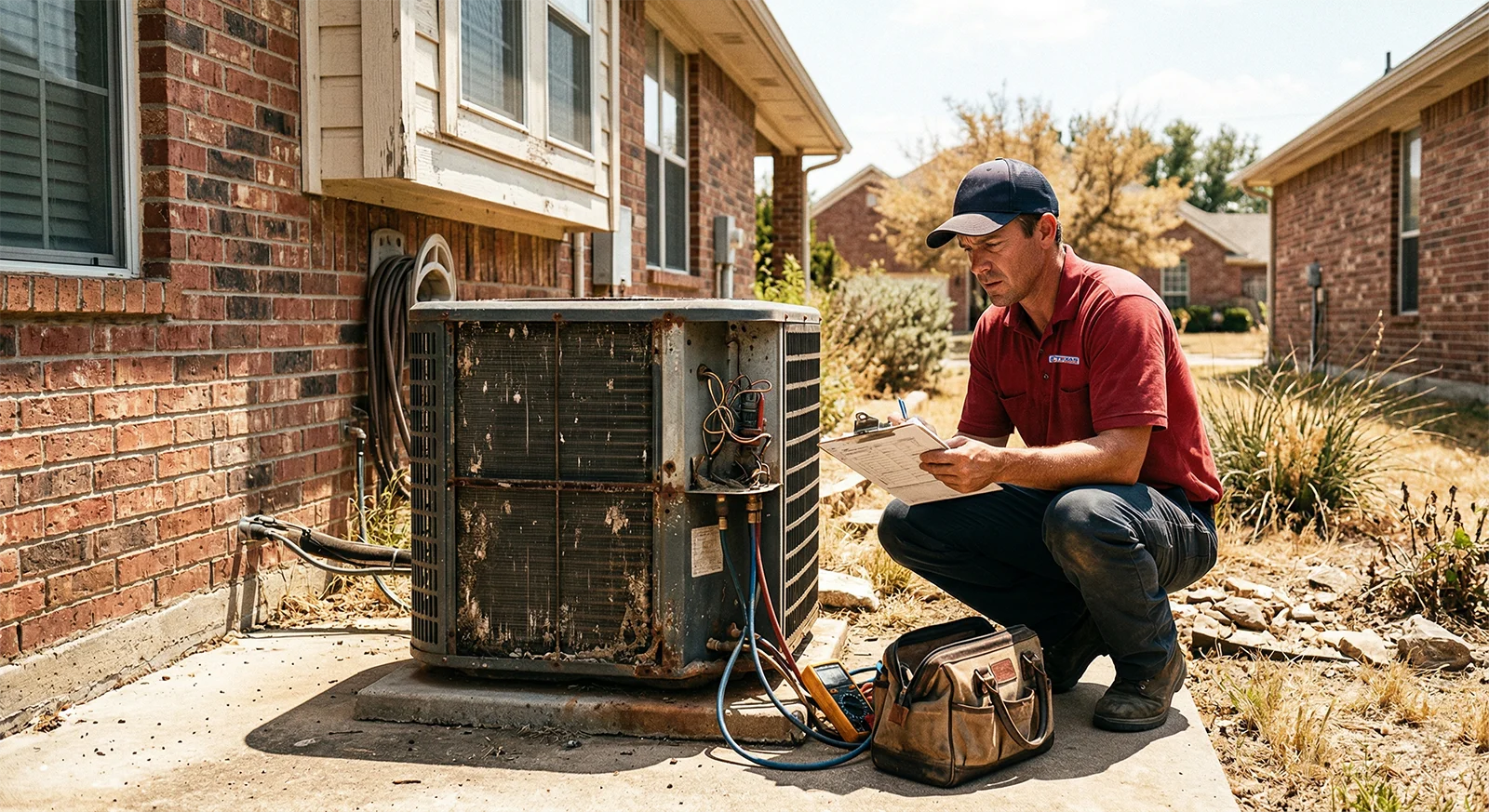
The most obvious sign is a system that keeps breaking down. One repair is a repair. Two repairs in the same season is a pattern. Three repairs is the system telling you something. Each emergency AC repair call is not just the cost of the fix — it’s the cost of the downtime, the disruption to your business, and the wear from whatever caused the failure in the first place.
Beyond breakdowns, pay attention to your energy bills. If your summer electric bills have been climbing year over year without a change in how you’re using the space, your system is likely losing efficiency. Older equipment loses its ability to maintain rated performance as components wear — and in Bexar County, where systems run hard from spring through fall, that degradation happens faster than the national average. A system that’s costing you $100 or more per month in excess energy costs compared to a newer, properly sized unit is already paying for its own replacement, just slowly and without your permission.
Age is the other factor. Most commercial HVAC systems are rated for a lifespan of ten to fifteen years under normal operating conditions. In Bexar County, where cooling degree days exceed 2,500 annually and temperatures regularly push past 100°F, “normal” is doing a lot of work. If your system is approaching or past the twelve-year mark, the probability of a major failure — compressor, heat exchanger, refrigerant system — goes up significantly every year you hold on. Systems manufactured before around 2010 may also still be running R-22 refrigerant, which has been phased out and is increasingly expensive and difficult to source. That alone can make repair costs climb fast.
The honest evaluation we do when we come out to a commercial property isn’t just “what broke.” It’s the full picture — system age, repair history, current efficiency, and what a properly sized replacement would realistically cost versus what you’re likely to spend over the next three to five years keeping the current one alive.
Which San Antonio Businesses Are the Best Fit for VRF vs. Traditional HVAC?
Not every commercial property needs VRF, and we’re not going to tell you otherwise. A straightforward single-zone space with good existing ductwork and a system that’s only a few years old may be better served by a high-efficiency traditional replacement when the time comes. The goal is the right system for your situation — not the most expensive one.
That said, there are commercial applications in Bexar County where VRF makes a genuinely compelling case. Restaurants are a good example. The kitchen and dining room have completely different thermal loads, and the ability to condition them independently — without a patchwork of window units or a rooftop system that can’t distinguish between the two — is a real operational advantage. The Pearl District and River Walk corridor are full of restaurants dealing with exactly this problem.
Medical offices and clinics are another strong fit. Patient comfort and air quality matter, and the precise humidity control that comes with variable-speed operation is clinically relevant, not just a comfort perk. Multi-tenant office buildings along the Loop 1604 corridor, retail spaces in mixed-use developments, and older commercial buildings in Alamo Heights or downtown San Antonio where ductwork replacement would be prohibitively expensive — these are all situations where VRF earns its higher upfront cost.
For smaller single-zone commercial spaces — a standalone retail shop, a small office suite, a straightforward warehouse — a well-sized traditional split system or mini-split may be the more practical answer. The key is an honest assessment of the space, the occupancy patterns, and the long-term energy cost picture. That’s the conversation we have before we recommend anything.
One thing worth knowing: not every HVAC contractor in Bexar County is qualified to install VRF. It requires specialized training and equipment beyond a standard TDLR license. We install and service both VRF and VRV systems, which is not something most local residential-leaning HVAC companies can say.
Choosing the Right Commercial HVAC System in San Antonio, TX
The short version: VRF offers real advantages for multi-zone commercial spaces, older buildings without good ductwork, and businesses where energy costs and downtime are serious concerns. Traditional HVAC is still the right answer for plenty of applications — and a high-efficiency replacement, properly sized, will outperform an aging system by a wide margin regardless of which direction you go.
What matters most is getting an honest evaluation from someone who knows both systems and isn’t trying to steer you toward the more expensive option by default. We’ve been doing this work in Bexar County for over 30 years, and our approach hasn’t changed: look at the full picture, tell you what we actually think, and let you make the call.
If your commercial system is aging, underperforming, or you’re planning a renovation and want to get the HVAC decision right before construction starts, reach out to Texas Air Repair. We’re available 24/7, we serve the full Bexar County area, and we’ll give you a straight answer.