Your energy bill drops because your system isn’t fighting itself anymore. You’re not adjusting the thermostat every hour hoping something changes. When you walk into your house at 3 PM in July, it’s actually cool.
That’s what happens when your HVAC contractor in San Antonio, TX knows how to handle the climate here. San Antonio delivered 75 days over 100 degrees in 2023 alone. Your AC isn’t just cooling—it’s removing humidity while running 12 to 16 hours daily during summer. That’s double duty most systems weren’t designed to handle continuously.
A properly maintained system uses 25% less energy than one that’s been ignored. In San Antonio, that 25% penalty costs you $200 to $400 extra every season. You’re paying more every month for worse performance, and the system’s wearing out faster because it’s working harder than it should.
When your local HVAC service provider actually understands what your equipment faces here, you get cooler air, lower bills, and a system that lasts years longer than it would otherwise.
We’re a veteran-owned air conditioning contractor that’s been handling San Antonio’s HVAC demands for over two decades. We’re licensed, certified, and we’ve seen what happens to systems that run in this climate without proper care.
You’re not getting a national chain that rotates techs every six months. You’re getting people who’ve worked in San Antonio long enough to know that standard once-a-year maintenance doesn’t cut it when systems operate under punishing conditions for months without relief.
We cover San Antonio, Houston, and Austin because we understand Texas. We know the difference between a system that’s failing and one that’s just being pushed beyond what it was designed to handle. And we know how to fix both.

You call or submit a request. We schedule a time that works for you, and if it’s an emergency, we’re available 24/7 because AC failures don’t wait for business hours.
Our certified technician shows up and diagnoses the problem. You get a clear explanation of what’s wrong, what it’ll take to fix it, and what it costs before any work starts. No surprises, no upselling, no pressure.
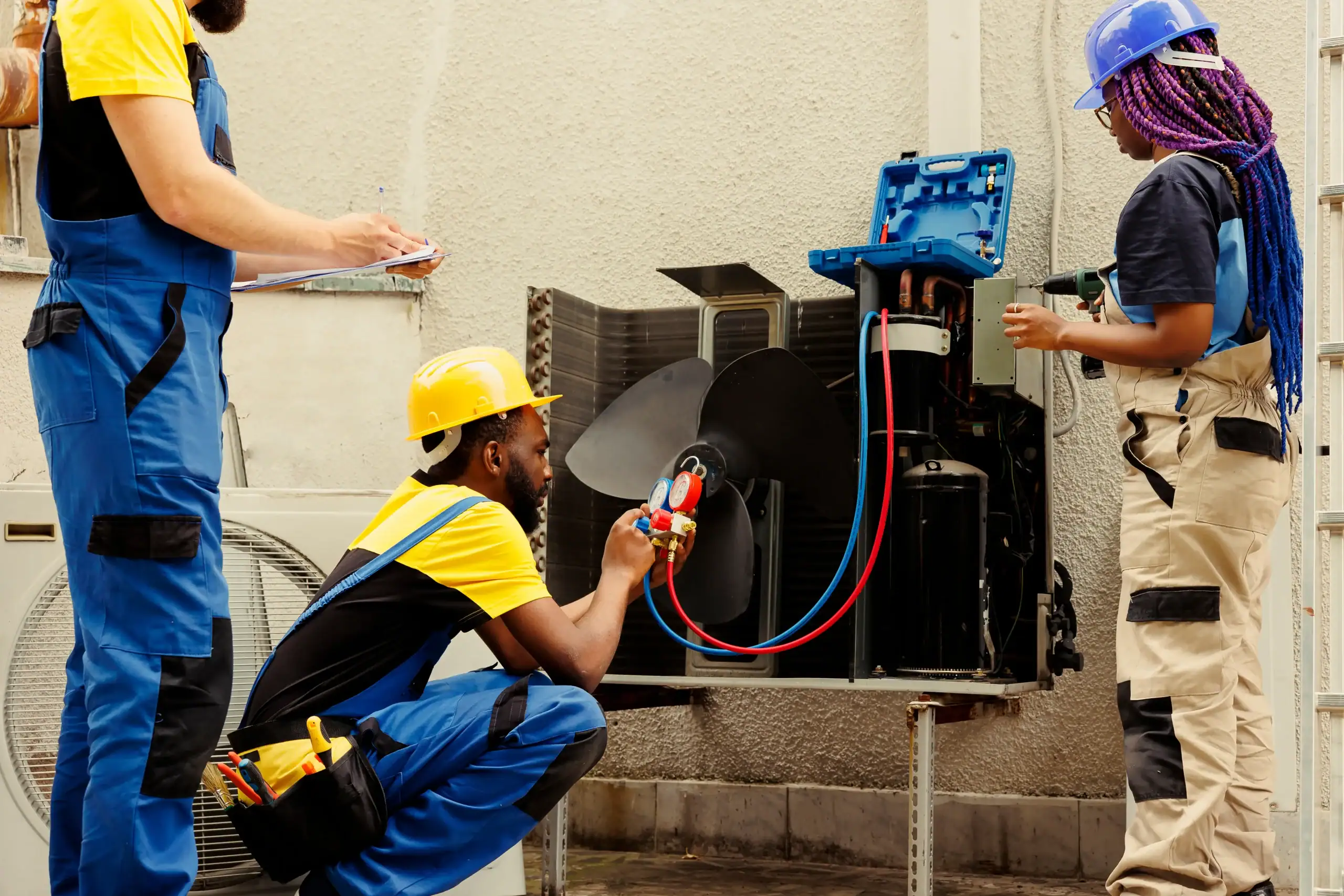
If it’s a repair, we fix it. If it’s maintenance, we go through your entire system—checking refrigerant levels, cleaning coils, inspecting electrical connections, testing airflow. If it’s an installation, we walk you through your options, including rebates and efficiency ratings, so you know exactly what you’re getting.
After the work’s done, we test everything to make sure it’s running right. You get a warranty on parts and labor. And if you want to stay ahead of breakdowns, we offer maintenance plans that match how hard your system actually works in San Antonio’s climate.
Ready to get started?
You get full-system diagnostics, not just a quick look at the obvious problem. We check refrigerant levels, airflow, electrical components, and the condition of your coils and filters. If something’s wearing out, you’ll know before it fails.
For installations, you’re looking at high-efficiency systems that qualify for federal rebates—up to $2,000 for heat pumps that meet efficiency standards. Heat pumps outsold gas furnaces by 25% in early 2025, and they’re a smart choice for San Antonio’s mild winters and long cooling seasons.
Indoor air quality is part of the conversation now. We install UV lights, air scrubbers, humidifiers, and dehumidifiers. We clean, sanitize, and seal ductwork. San Antonio’s humidity means your system is pulling moisture out of the air constantly, and that moisture creates conditions for mold and allergens if your ducts aren’t maintained.
Emergency repairs get priority because a system failure in July isn’t just uncomfortable—it’s dangerous. Frozen coils, refrigerant leaks, compressor failures—we’ve handled all of it, and we stock the parts to fix most issues the same day.

Twice a year minimum if your system runs as hard as most do here. Once before cooling season, once before heating season. That’s the standard advice, and it’s not wrong.
But here’s what that advice doesn’t account for: San Antonio systems run longer hours and cycle more frequently than systems in moderate climates. Your AC might run 12 to 16 hours daily for months straight. That’s an endurance test most equipment wasn’t designed for.
If your system is over 10 years old, if you’re running it hard from March through October, or if you’ve had reliability issues, you’re better off with quarterly check-ins. Preventive maintenance reduces breakdown risk by up to 95% when the service schedule actually matches the demands your system faces. Waiting until something breaks costs more in repairs and lost efficiency than staying ahead of it.
You’re losing 25% efficiency if the system hasn’t been maintained properly. In San Antonio, where your AC runs most of the year, that’s $200 to $400 in extra costs every season. That’s the immediate cost.
The bigger cost is the risk. A 15-year-old system in this climate is on borrowed time. When it fails in July, you’re not shopping around for the best deal—you’re paying emergency rates for whatever’s available. And if it fails on a weekend or holiday, you’re looking at premium service charges on top of that.
Most HVAC systems last about 15 years before major issues develop. With proper maintenance, you can stretch that to 20 or even 30 years. But if your system is past 15 and you’re spending $500+ on repairs annually, you’re better off replacing it. New high-efficiency systems qualify for federal rebates, and the energy savings alone can offset a chunk of the installation cost within a few years.
If the repair costs more than half of what a new system would cost, replace it. That’s the general rule, and it holds up most of the time.
But age matters too. If your system is under 10 years old and the repair is straightforward—a bad capacitor, a worn contactor, a refrigerant leak that can be sealed—repair it. If it’s over 15 years old and you’re looking at a compressor replacement or a major refrigerant leak, replacement makes more sense.
Here’s the other factor: if you’ve had multiple repairs in the last two years, the system’s telling you it’s done. Older systems also use R-22 refrigerant, which is being phased out and getting expensive. If your system needs R-22 and has a major leak, replacement is almost always the better call. We’ll walk you through the math so you can make the decision that actually makes sense for your situation.
Federal tax credits cover up to $2,000 for high-efficiency heat pumps and qualifying AC systems. That’s available to most homeowners, and it applies to systems that meet or exceed the highest efficiency tier outlined by the Consortium for Energy Efficiency.
Low-income households can claim up to 100% of heat pump installation costs, capped at $14,000. Moderate-income households can claim 50%, also capped at $14,000. The catch is that qualifying heat pumps often cost $3,000 more than standard models, and fewer than 10% of heat pumps currently meet the highest efficiency standard.
There are also utility rebates through CPS Energy for San Antonio residents who upgrade to high-efficiency systems. The rebate amounts change, but they’re usually a few hundred dollars for systems that meet specific SEER ratings. We stay current on what’s available and help you navigate the paperwork so you’re not leaving money on the table. The rebate process has strict requirements, and if the application isn’t done right, you won’t get the credit.
Low refrigerant is the most common cause. If there’s a leak, your system doesn’t have enough refrigerant to absorb heat, so it just blows air without actually cooling it. You’ll usually notice ice forming on the refrigerant lines or the evaporator coil if this is the issue.
Dirty coils are the second most common cause. When the evaporator or condenser coils are covered in dust and debris, they can’t transfer heat effectively. The system runs, but it’s not moving heat out of your house the way it should. This happens faster in San Antonio because of how much your system runs and how much dust and pollen we get.
A failing compressor is the worst-case scenario. The compressor is what pressurizes the refrigerant and moves it through the system. If it’s failing, the system can’t generate the pressure needed to cool your house. You’ll hear unusual noises—grinding, clicking, or stuttering—when the system tries to start. Compressor replacement is expensive, and if your system is over 12 years old, replacement usually makes more sense than repair.
Maintenance plans make sense if your system runs hard and you want to avoid emergency repairs. They don’t make sense if your system barely runs or if you’re planning to replace it in the next year or two.
Here’s what you’re actually paying for: scheduled service that catches problems before they become breakdowns, priority scheduling when something does go wrong, and discounts on repairs and parts. Most plans include two visits a year—one before cooling season, one before heating season.
The math works if you’re comparing it to emergency service rates. A maintenance visit costs $100 to $150. An emergency repair visit starts at $200 to $300 before any actual work gets done. If the plan saves you one emergency call, it’s paid for itself. And if it catches a $50 part failure before it turns into a $1,200 compressor replacement, it’s saved you real money.
The other benefit is lifespan. Systems that get regular maintenance last 5 to 10 years longer than systems that only get serviced when something breaks. In San Antonio, where your system works harder than most, that difference is even bigger.
Other Services we provide in San Antonio
 Call Now