Summary:
Your AC just made a noise you’ve never heard before. Or it’s been running for hours and your house still feels like an oven. In San Antonio, where your AC works harder than almost anywhere else in the country and temperatures regularly top 100°F, these aren’t just annoyances—they’re warnings. Ignore them and you’re looking at an emergency breakdown on the hottest day of summer. Catch them early and you might save yourself thousands. Here’s what your AC is trying to tell you and when it’s time to call us for help.
Your AC Runs But Won't Cool Your House
This is the problem that makes you question everything. The system sounds like it’s working. You hear the fan. But your house stays hot and you’re sweating on your own couch.
When your AC runs without cooling, it’s usually one of a few specific issues. Low refrigerant from a leak. A failing compressor that can’t pressurize the refrigerant. Airflow problems from clogged filters or dirty coils. Sometimes it’s a thermostat reading the wrong temperature or stuck in the wrong mode.
You might see uneven cooling—some rooms fine, others unbearable. Or your system runs nonstop without ever hitting the temperature you set. Both tell you the same thing: your AC is working overtime and still failing.
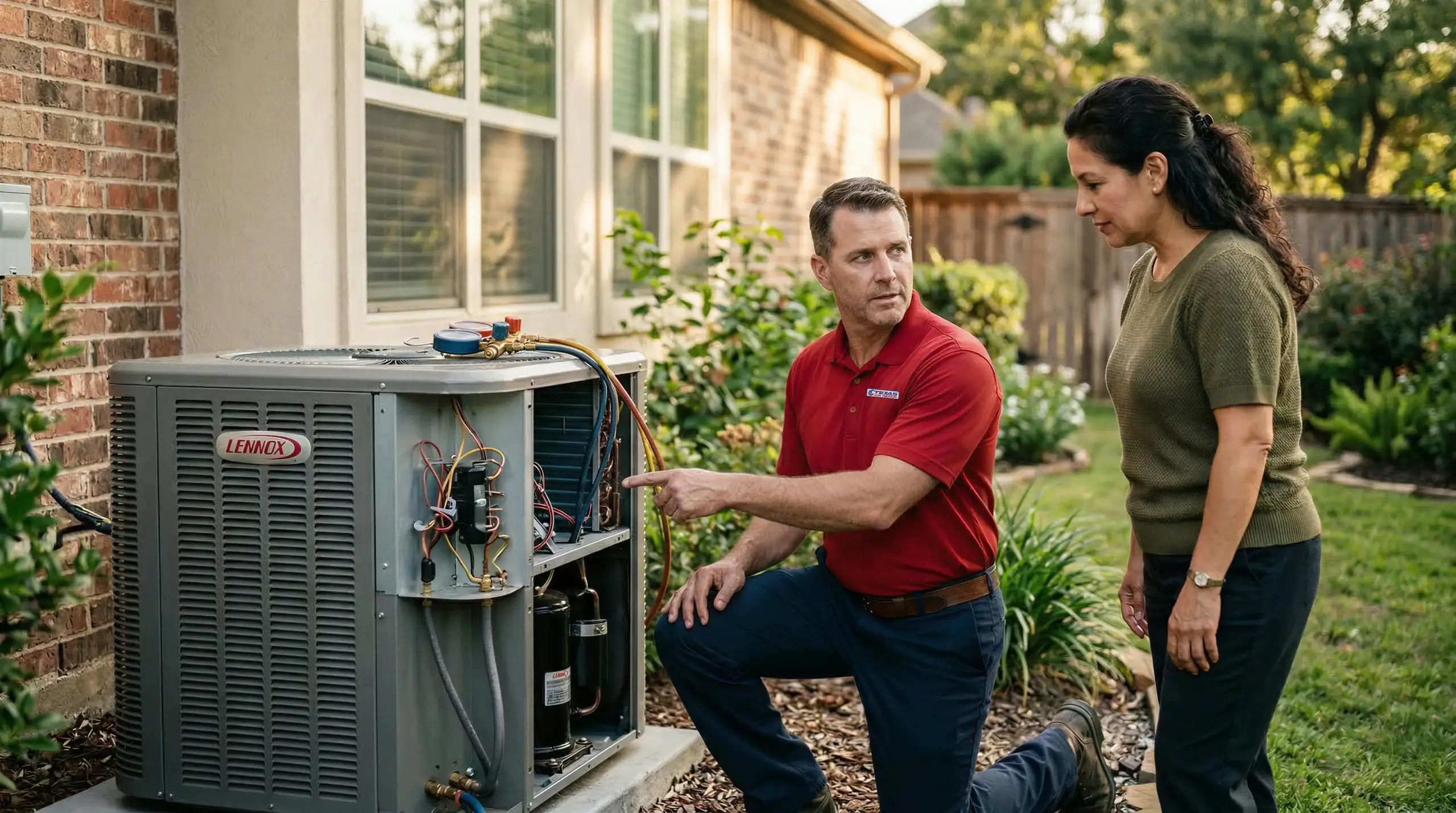
Why Your AC Blows Warm Air Instead of Cold
Start simple. Check your thermostat. Make sure it’s set to “cool” and not “heat” or “fan only.” If the fan is set to “on” instead of “auto,” your system blows air even between cooling cycles, and that air feels warm.
Settings look right? The problem runs deeper. Low refrigerant is the most common cause—refrigerant is what actually cools the air, so when levels drop from a leak, your system can’t do its job. You might see ice on the outdoor unit or hear hissing sounds.
A failing compressor causes warm air too. The compressor moves refrigerant through your system. When it quits, cooling stops. Compressor repairs run into thousands of dollars, which is why catching problems early matters so much.
Dirty evaporator coils absorb heat from your indoor air. Cover them in dust and grime and they can’t work. The air coming from your vents stays warm. Blocked or leaking ducts let cooled air escape before it reaches your rooms. You’re left with weak, warm airflow and high energy bills.
San Antonio’s heat makes this more than uncomfortable—it’s a health risk, especially for kids, elderly family members, or anyone with medical conditions. If the basics check out and the problem persists, call us for a professional inspection. Guessing costs more than knowing.
AC Running Nonstop Without Reaching Set Temperature
An AC that never shuts off is screaming at you. Sure, extreme heat makes your system run longer. But nonstop operation while your house stays hot? That’s different.
Undersized systems can’t keep up. If your AC was never properly sized for your home, it’ll work itself to death trying to cool a space it wasn’t designed to handle. San Antonio’s heat amplifies this problem. An undersized unit will run constantly and still fail you.
Dirty filters choke airflow. When filters clog with dust and debris, your system works harder and runs longer just to push air through. It still might not cool effectively. Change your filter every one to three months. It’s basic, but it works.
Low refrigerant causes constant running too. Your AC keeps trying to reach the temperature you set, but it physically can’t get there. This wastes energy and puts extra strain on your compressor—turning a refrigerant leak into a compressor failure.
Thermostat issues trick your system. If your thermostat sits near a window or lamp, it thinks your house is warmer than it is. Faulty sensors do the same. Sometimes it’s just dead batteries causing bad readings.
Leaky ductwork bleeds cooled air into your attic or walls. You might have a perfectly good AC, but if 20 to 30 percent of your cooled air escapes before reaching your rooms, your system will never catch up. Sealing ducts makes a real difference in comfort and cost.
Don’t accept constant running and high bills. The longer your AC strains, the closer you are to a complete breakdown. Professional inspection tells you whether you need a simple filter change or you’re dealing with refrigerant loss and duct leaks. One saves you money. The other saves you from an emergency.
Strange Noises Mean Something's Broken or Breaking
Your AC should hum quietly. Grinding metal, banging, screeching, rattling—these aren’t normal. They’re warnings that something inside is broken or about to break.
Different sounds point to different problems. Grinding usually means worn motor bearings or a fan blade scraping housing. Banging indicates loose or broken parts in the compressor or blower. Screeching points to belt issues or motors that need lubrication.
These sounds don’t go away on their own. They get worse. And the longer you wait, the more expensive the fix becomes.
Grinding and Banging Sounds From Your AC Unit
Grinding is metal on metal. Motor bearings wear out from heat, friction, and lack of lubrication. When they go, the motor grinds as it tries to spin. Keep running it and the motor overheats and fails. You go from replacing bearings to replacing the entire motor.
Grinding from your outdoor unit usually means compressor trouble. Internal pistons that pressurize refrigerant wear out and scrape against other components. Compressor failure is one of the most expensive AC repairs—often running several thousand dollars. On older systems, compressor failure means it’s time to replace the whole unit, not just the part.
Banging when your AC starts up? Could be debris in the outdoor unit—sticks, leaves, something caught in the fan. Or it’s a loose fan blade hitting the housing. Banging from inside your house points to blower fan problems—loose fan or failed motor mounts.
Banging from the compressor is serious. Broken piston pins, connecting rods, or other internal parts bang around inside the housing. Keep running it and you go from repairing one component to replacing the compressor or the entire system.
Rattling is usually simpler but still needs attention. Loose panels, covers, screws, or bolts vibrating free. Sometimes it’s debris in the fan. Rattling might not mean catastrophic failure, but loose parts hitting other components cause secondary damage. It’s also a sign your system needs maintenance.
Hear any of these noises? Turn off your AC and call us. Running a grinding, banging, or rattling system turns a manageable repair into complete failure. In San Antonio’s heat, you can’t afford to be without AC while waiting for parts or a new system.
Hissing, Bubbling, Screeching—What They're Telling You
Hissing or bubbling means refrigerant leak. Refrigerant runs under high pressure in your system’s closed loop. Cracks or holes in the lines or coils let it escape with a hissing sound. Leaks in liquid lines create bubbling.
Refrigerant leaks are serious on multiple levels. Your AC can’t cool without adequate refrigerant. As levels drop, cooling capacity drops, and your system runs longer and works harder. Low refrigerant freezes your evaporator coil, causing water damage and more repairs. And refrigerant handling requires an EPA license—you need a professional to find the leak, fix it, and recharge your system.
Systems using R-22 refrigerant (common before 2010) make leaks even costlier. R-22 was phased out in 2020. What’s left is expensive and hard to find. If you have an older system with an R-22 leak, replacement often makes more financial sense than repair.
Screeching or squealing comes from blower motors or fan motors. Worn bearings or loose, damaged belts create high-pitched sounds. Some older systems use belts to connect motors to fans. When those belts wear out, they slip and squeal.
Screeching can also mean dangerously high compressor pressure. Internal pressure builds too high and the compressor makes a loud, shrill noise before it fails. This is an emergency—shut down your system and call us for service immediately. Running a compressor under extreme pressure can cause it to seize or rupture.
Buzzing points to electrical problems. Failing capacitors, loose wiring, malfunctioning contactors, or circuit breaker issues. Electrical problems are safety hazards and system failure causes. They need professional attention now.
San Antonio’s climate makes your AC run almost constantly during summer. Worn parts and failing components show up faster here than in milder climates. Catch sound-related warnings early and you prevent emergency breakdowns and keep repair costs manageable. Your AC is making noise it shouldn’t? Get it checked before the problem multiplies.
What to Do When Your AC Shows Warning Signs
Your AC tells you when something’s wrong before it quits completely. Weak airflow, warm air, strange noises, nonstop running, rising energy bills—these are all calls for help. Catch them early and you keep repair costs down. Ignore them and you’re looking at an emergency breakdown during the hottest stretch of summer.
If you’re seeing any of these warning signs, don’t wait for total failure. We provide professional inspection that diagnoses the problem, gives you a clear estimate, and helps you decide whether repair or replacement makes sense for your situation. We’ve been helping San Antonio homeowners with honest, reliable AC repair services for over 30 years, with 24/7 emergency service when you need it most.