Summary:
Your AC just died again. Third time this summer. The technician’s giving you that look—the one that says “we can fix it, but…” You’re wondering if you’re throwing good money after bad, and honestly, you probably are.
San Antonio heat doesn’t give you the luxury of waiting. When temperatures push past 100 degrees for weeks on end, your air conditioner isn’t optional. It’s running nearly nonstop from May through September, and that kind of workload takes a toll. If your system is over a decade old, struggling to keep up, or costing you more in repairs than it’s worth, you’re likely facing a decision you’ve been putting off.
Here’s what you actually need to know about AC replacement in San Antonio—the real costs, the questions that matter, and how to make sure you’re getting a system that’ll last.
When AC Repair Stops Making Sense
There’s a point where fixing your air conditioner becomes more expensive than replacing it. That line isn’t always obvious, especially when you’re getting conflicting advice from different contractors.
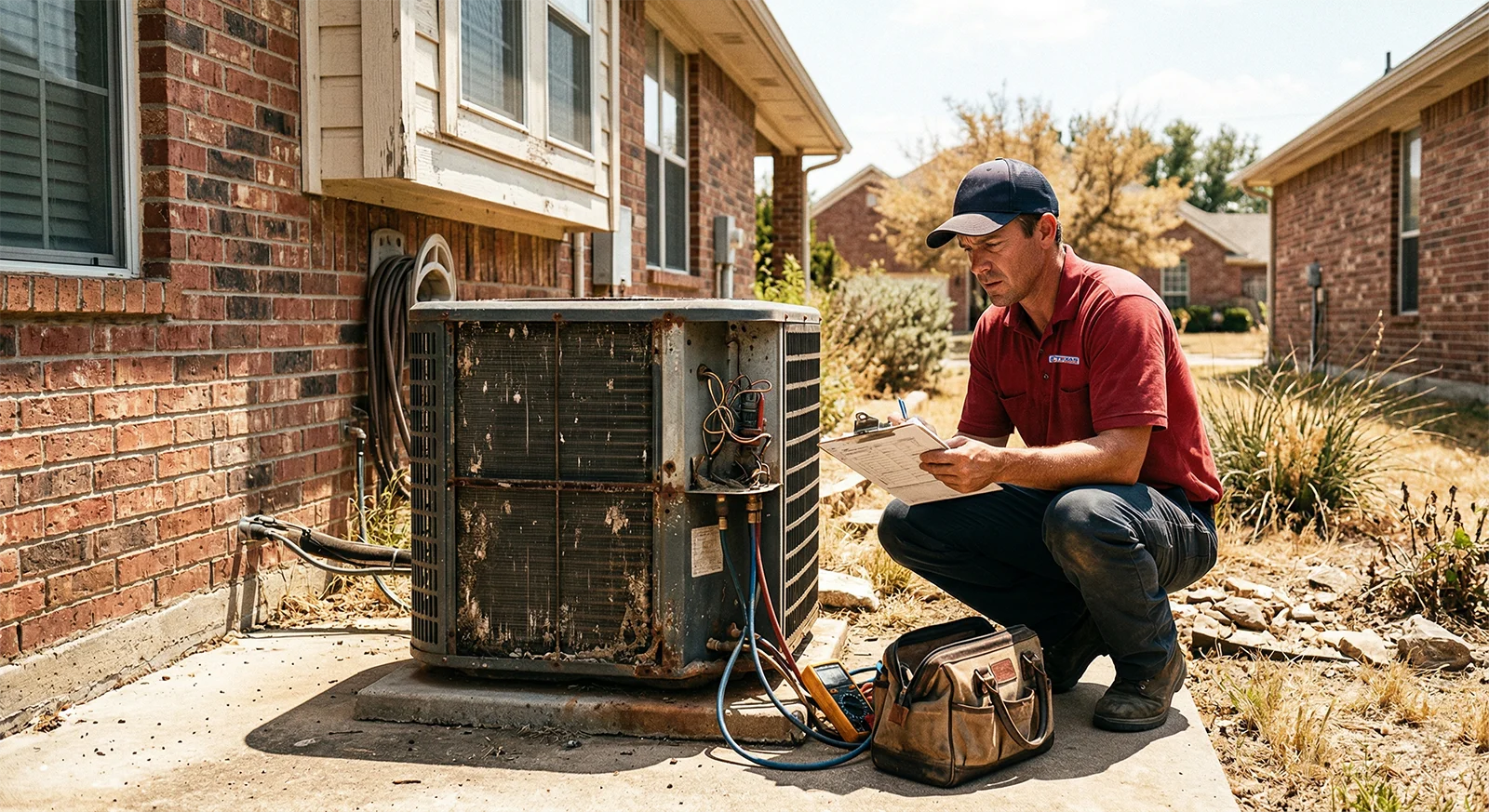
If your system is 10 to 15 years old, you’re in what most HVAC pros call the replacement zone. Units in San Antonio, TX work harder than systems in milder climates because they’re running almost year-round. That constant demand wears down compressors, refrigerant lines, and electrical components faster than normal.
Frequent repairs are the clearest signal. If you’re calling for AC repair services twice a year or more, your system is telling you it’s done. Those repair bills add up fast, and at some point you’re just funding a slow decline instead of investing in something reliable.
What You'll Actually Pay for AC Replacement Cost in San Antonio
New air conditioner installation in San Antonio typically runs between $6,000 and $18,000, with most homeowners paying around $9,500. That’s a wide range, and the final number depends on factors that actually matter—not just the sticker price on the equipment.
System size is the biggest driver. A 3-ton unit for a 1,500 to 1,800 square foot home costs less than a 4-ton or 5-ton system for larger spaces. But size alone doesn’t tell the whole story. Your home’s insulation, ductwork condition, window quality, and even which direction your house faces all affect what you’ll need.
SEER2 ratings make a difference too. Texas requires a minimum SEER2 rating of 14.3 for new installations, but higher-efficiency units (16 SEER2 or above) cost more upfront while cutting your monthly energy bills by 20 to 40 percent. If you’re currently spending $300 a month to cool your home in summer, an energy-efficient AC could drop that to $150 to $200. Over five years, that’s $3,000 to $4,500 back in your pocket.
Installation complexity affects the price. If your ductwork needs repairs, sealing, or replacement, that adds $1,000 to $5,000 or more. Older homes sometimes need electrical panel upgrades to handle modern AC units. Permit fees in San Antonio can run $100 to $500 depending on your specific location and the scope of work.
Don’t forget about available rebates. High-efficiency systems can qualify you for incentives ranging from $300 to $3,500 depending on your utility provider and the equipment you choose. These rebates effectively reduce your AC replacement cost and improve your return on investment.
The key is getting an accurate estimate based on your actual home—not a ballpark figure based on square footage alone. A proper load calculation accounts for everything that affects cooling demand, and it’s the only way to know what you really need.
Clear Warning Signs Your System Needs Replacement
Age tops the list. The average lifespan of a central air conditioning unit is 10 to 15 years, and that lifespan shrinks in San Antonio, TX where systems run nearly nonstop for six months every year. If your unit is pushing that age range and showing other problems, replacement usually makes more sense than repair.
Rising energy bills are a red flag. If your cooling costs have climbed year over year without a corresponding rate increase or weather change, your system is losing efficiency. Older units work harder to produce the same cooling, burning more electricity to get the job done. At some point, the monthly waste exceeds what you’d pay financing a new system.
Uneven cooling tells you the system can’t keep up. If some rooms are freezing while others stay warm, or if your home feels humid even when the AC is running, the unit isn’t doing its job. That could mean undersizing, failing components, or ductwork issues—but when combined with age and other symptoms, it points toward replacement.
Strange noises aren’t normal. Grinding, banging, or squealing sounds indicate mechanical problems—loose parts, failing motors, or worn components. These can sometimes be fixed, but on older systems they’re often symptoms of broader decline. One repair leads to another, and you end up chasing problems instead of solving them.
Refrigerant leaks are expensive to fix and often recurring. If your system uses R-22 refrigerant (common in units installed before 2010), recharging it costs significantly more than it used to because R-22 production was phased out. Modern systems use more environmentally friendly refrigerants and run more efficiently overall.
Frequent cycling is another warning sign. If your AC turns on and off constantly without completing full cooling cycles, it’s either oversized for your space or failing. Short cycling wastes energy, increases wear on components, and leaves your home humid and uncomfortable.
The $5,000 rule gives you a quick decision framework. Multiply your system’s age by the cost of the proposed repair. If the result exceeds $5,000, replacement is usually the smarter investment. For example, a 12-year-old system needing a $500 repair gives you $6,000—well over the threshold.
How to Choose the Best AC Replacement for Your Home
Picking the right AC replacement means understanding what your home actually needs, not just buying the biggest or cheapest unit available. San Antonio’s climate demands reliable cooling, but the right system depends on factors specific to your property.
Proper sizing matters more than most homeowners realize. An oversized unit cools the air quickly but shuts off before removing humidity, leaving your home feeling cold and clammy. An undersized unit runs constantly without ever reaching the set temperature, driving up energy bills and wearing out faster.
The general rule is one ton of cooling for every 500 to 600 square feet, but that’s just a starting point. Your home’s insulation, window quality, ceiling height, and sun exposure all affect cooling demand. A professional load calculation—called a Manual J—accounts for these variables and tells you exactly what capacity you need.
Understanding SEER2 Ratings and Why They Matter for AC Upgrade Options
SEER2 is the updated efficiency standard that replaced the old SEER rating in 2023. It measures how much cooling your system produces per unit of electricity consumed, using more realistic testing conditions than the old standard. Higher numbers mean better efficiency and lower operating costs.
Texas requires a minimum SEER2 rating of 14.3 for new split-system air conditioners. That’s the legal floor, not necessarily what you should aim for. Units rated 16 SEER2 or higher cost more upfront but deliver significant long-term savings, especially in San Antonio, TX where your AC runs heavily for six months or more each year.
The efficiency gap between old and new systems is substantial. If you’re replacing a unit from 2010 or earlier, it probably has a SEER rating of 10 to 13. Upgrading to a modern 16 SEER2 system can reduce your cooling costs by 30 to 40 percent. That’s not a small difference when you’re running the AC nearly every day from May through September.
Modern high-efficiency systems include features that older units lack. Variable-speed compressors adjust output to match demand instead of running at full blast all the time. This improves comfort, reduces humidity better, and extends equipment life by reducing wear. Smart thermostats let you control temperatures remotely and optimize run times based on your schedule.
The payback period on higher-efficiency equipment is real. While a 16 SEER2 or 18 SEER2 system costs more than the minimum-rated unit, the energy savings often cover the difference within three to five years. After that, you’re just banking the monthly savings while enjoying better comfort and reliability.
Don’t forget about rebates and tax credits. Federal and state programs offer incentives for installing high-efficiency HVAC systems. These can range from $300 to $3,500 depending on the equipment and your specific situation. Your HVAC contractor should know what’s currently available and help you qualify for any applicable programs.
Keep in mind that efficiency ratings assume proper installation. Even the most efficient system underperforms if it’s incorrectly sized, poorly installed, or connected to leaky ductwork. That’s why working with experienced HVAC contractors matters just as much as the equipment you choose.
What to Ask HVAC Contractors Before You Commit
Not all HVAC contractors approach AC replacement the same way. Some do thorough assessments and proper load calculations. Others eyeball your existing unit and recommend the same size or bigger “to be safe.” The questions you ask help you spot the difference.
Start with sizing. Ask if they’ll perform a Manual J load calculation or if they’re basing the recommendation on your current system. Proper sizing requires measuring your home’s actual cooling demand, not just matching what’s already installed. If they skip this step, you might end up with an oversized or undersized system that costs you money and comfort.
Ask about ductwork. Are they inspecting your ducts for leaks, damage, or sizing issues? Leaky ductwork can reduce cooling capacity by 20 to 30 percent, which means even a new high-efficiency system won’t perform as expected. Good contractors check duct condition and recommend repairs or sealing when needed.
Find out what brands they install and why. You don’t need a sales pitch, but you should understand what equipment they’re recommending and whether it’s appropriate for your home and budget. Ask about warranty coverage on both parts and labor, and make sure you understand what’s included.
Clarify the installation process. How long will it take? What’s included in the quoted price? Are permits, disposal of the old unit, and any necessary electrical or ductwork modifications covered, or will those be additional charges? Transparent contractors provide detailed quotes that break down exactly what you’re paying for.
Ask about their experience with San Antonio’s climate. Local knowledge matters because contractors familiar with the area understand the specific challenges—extreme heat, high humidity, dust, and long cooling seasons. They know what systems hold up best and what common issues to watch for during new air conditioner installation.
Check their licensing and insurance. Texas requires HVAC contractors to be licensed, and reputable companies carry liability insurance and workers’ compensation. Don’t hesitate to ask for proof. You’re protecting yourself from liability if something goes wrong during installation.
Find out about ongoing maintenance. Do they offer service plans or preventive maintenance programs? Regular maintenance extends system life and catches small problems before they become expensive failures. Companies that stand behind their work usually offer maintenance options to protect your investment.
Get multiple quotes, but don’t automatically choose the lowest price. The cheapest bid often comes with corners cut—undersized equipment, skipped load calculations, minimal warranty coverage, or subcontractor labor. You’re better off paying a fair price for quality work than saving a few hundred dollars upfront and dealing with problems later.
Making the Right AC Replacement Decision in San Antonio
AC replacement is a significant investment, but it’s one that pays off when done right. You’re not just buying equipment—you’re buying comfort, lower energy bills, and peace of mind during San Antonio’s brutal summers.
The key is making decisions based on your actual home and needs, not rules of thumb or sales pressure. Get a proper load calculation. Choose efficiency levels that make sense for how much you run your AC. Work with contractors who do thorough assessments and stand behind their work.
If your system is over 10 years old, struggling to keep up, or costing you more in repairs than it’s worth, now is the time to explore replacement options. Waiting until it fails completely during a heat wave leaves you with fewer choices, longer wait times, and higher costs. For honest assessments and professional AC replacement in San Antonio, TX, we bring over 20 years of experience helping homeowners make smart decisions about their cooling systems.